THURSDAY, APRIL 9, 2026. BY STUART SPENCER, LODI WINEGRAPE COMMISSION.
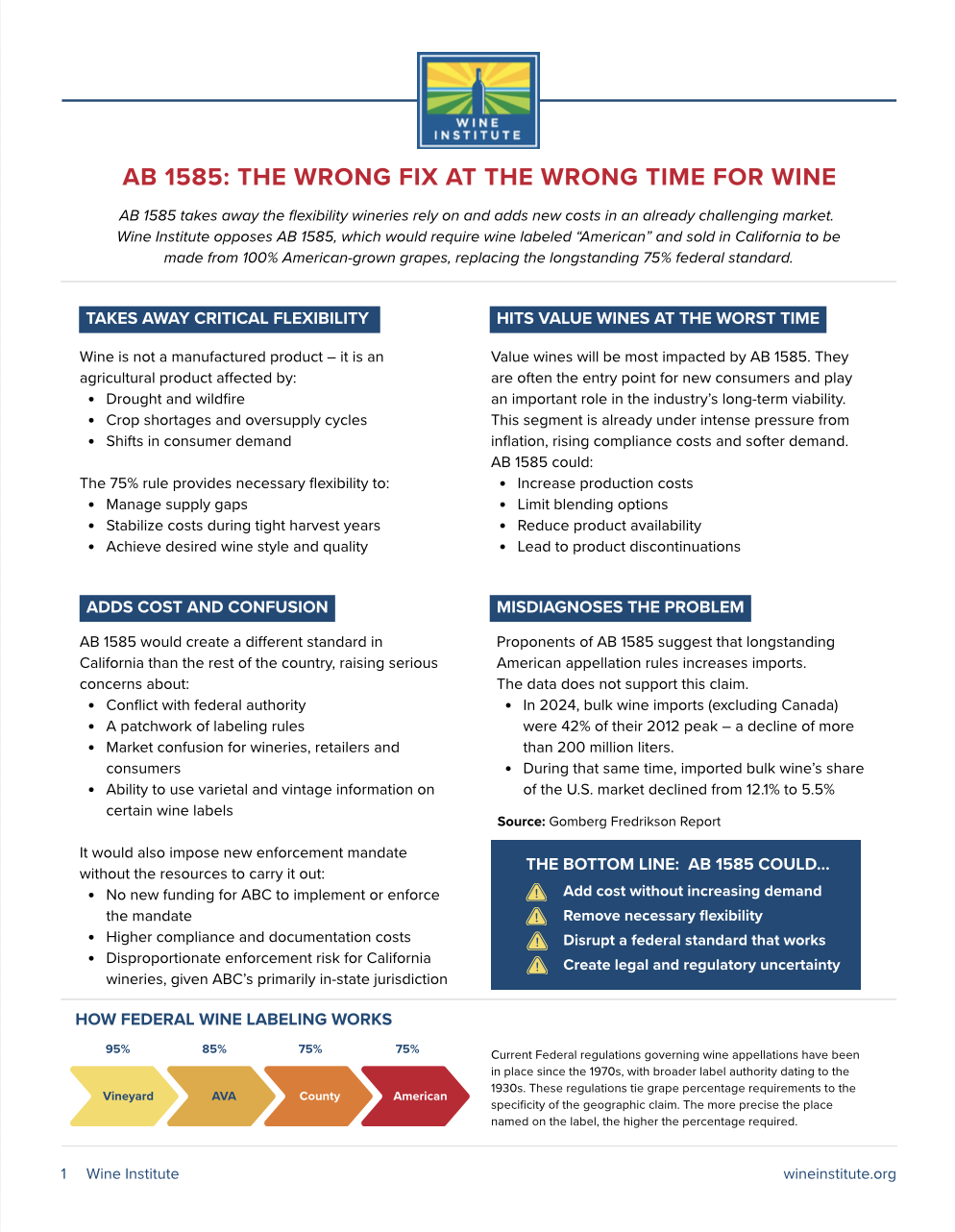
In February, California vintners attending Wine Paris were provided with a talking point from the Wine Institute intended to help frame conversations with international partners amid ongoing tariff discussions and broader U.S. trade tensions: “Wine is unique from many agricultural products due to its inherent tie to its place of origin and the unique qualities and characteristics of that particular winegrowing region. Unlike commodities, wines from one part of the world are not interchangeable with wines from another.”
That principle is correct. Most growers and vintners would agree with it. Which is why Wine Institute’s opposition to Assembly Bill 1585 is so difficult to understand.
Assembly Bill (AB) 1585 is straightforward. Under current federal rules, a wine labeled “American” can legally contain up to 25% foreign wine. This bill would require that wine sold in California under an “American” label be made from 100% American-grown grapes. It does not ban imports. It does not restrict blending. It does not limit consumer choice. It simply requires that the label mean what it says.
The United States is the only major wine-producing country that allows its national designation to include foreign wine.¹ Wines labeled French must come from French wine. Wines labeled Italian must come from Italian wine. AB 1585 would bring California in line with a standard that the rest of the world already applies.
The legislation is co-sponsored by the California Association of Winegrape Growers (CAWG) and Family Winemakers of California (FWC), and is supported by more than 17 regional wine associations and thousands of growers and vintners across the state of California.
Wine Institute opposes it. Their arguments, shown below, deserve scrutiny.
A Manufactured Divide
In early communication to regional associations just days after AB 1585’s introduction and before any formal committee deliberation, Wine Institute stated that opposition to AB 1585 was already “increasingly likely.” At the same time, the message warned that moving forward with the legislation could create division between growers and wineries.
That framing is not incidental. It creates the impression that this is an internal industry dispute; growers versus wineries. And in Sacramento, that matters. Legislators are often reluctant to intervene when an industry appears divided.
But that is not what is happening here.
A handful of sizeable, multinational companies benefit from the current loophole that allows foreign wine to be blended into products labeled “American.” Preserving that flexibility protects their profits. Framing this as an industry-wide dispute obscures the truth: this is not growers versus wineries. It’s whether a loophole that benefits a handful of large players should continue, even as growers and many wineries across California call for a straightforward standard: if a wine is labeled “American,” it should be made from American grapes.
It’s Not About Flexibility, It’s About Cost
Wine Institute’s central claim is that the current rule provides “critical flexibility” to manage supply and stabilize costs. But what kind of flexibility is being defended?
When Wine Institute refers to “cost stabilization,” it is referring to the ability to blend lower-cost imported bulk wine into domestic products. That is not about managing supply gaps in a crisis year. It is about access to cheaper wine.
Framed honestly, this is not a supply argument. It is a cost argument. It is about preserving the ability to substitute imported wine for domestic production when it is economically advantageous.
In a market where thousands of winegrowers sell to a relatively small number of large buyers, that imbalance has real consequences. When buyers shift toward imports, demand for California grapes falls, putting clear downward pressure on prices.
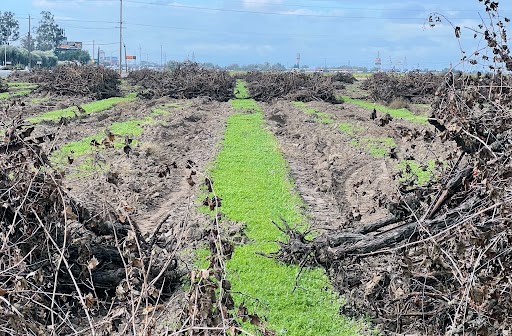
That is the economic reality growers are living in today as thousands of acres of vineyards are being removed across California.
What the Import Data Actually Shows
Wine Institute’s advocacy suggests that imports are not a meaningful factor, pointing to a decline from a 2012 peak as evidence. That framing is incomplete and misleading. It relies on a single high-water mark to suggest improvement while ignoring more recent trends and the continued impact of bulk imports on the California grape and wine market.
In 2025 alone, bulk wine imports increased 19%, adding roughly 45 million gallons into the U.S. market. That surge of supply directly competes with California grapes and wine and delays the industry’s recovery.
Over the past two decades, a pattern is visible in the data: when grape prices begin to rise, imports surge. That additional supply suppresses demand for California winegrapes and puts downward pressure on prices. This is not hyperbole; it is visible in the chart below.
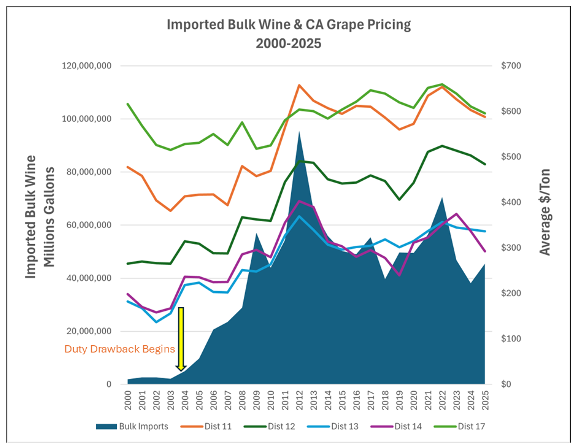
This chart shows imported bulk wine volumes (2000–2025) alongside average grape prices in Crush Districts 11, 12, 13, 14, and 17, which represent roughly 68–70% of California’s winegrape crush. Over time, bulk imports rise sharply when grape prices increase, indicating imports are used to offset higher domestic costs. The expansion of duty drawback around 2004 aligns with the start of this trend.
Source: Gomberg Fredrickson Report & California Department of Agriculture, Grape Crush Report
Much of that imported wine is not visible to consumers. It is blended into products labeled “American,” masking its origin while directly displacing domestic production. Those imports represent hundreds of thousands of tons of grapes. At the same time, hundreds of thousands of tons of California fruit have gone unharvested, and vineyards across the state are being removed for lack of buyers.
Those realities are unfolding in parallel. It is difficult to see them as anything but connected.
How Federal Policy Encourages Imports
The problem is not just market dynamics. Federal policy actively encourages imports.
A loophole in the Duty Drawback program allows companies to recover alcohol taxes paid on imported bulk wine when a similar wine is exported. Because wine operates under a special carve-out rule, that exported wine does not have to be the same product.
The result: companies can import cheap bulk wine, export domestic wine, and receive a tax refund tied to the import. In effect, imported bulk wine enters the U.S. market virtually tax-free creating a financial incentive to choose imports over local farmers.
In a market where buying power is concentrated among a small number of large companies, that incentive drives behavior. It encourages imports, reduces demand for California grapes, and reinforces the very “flexibility” being defended.
Wine Institute supports maintaining the duty drawback loophole and is opposing AB 1585. Taken together, Wine Institute’s positions encourage imports, weaken demand for California grapes, and undermine the growers, workers, and rural communities that depend on this industry.
What Consumers Actually Want
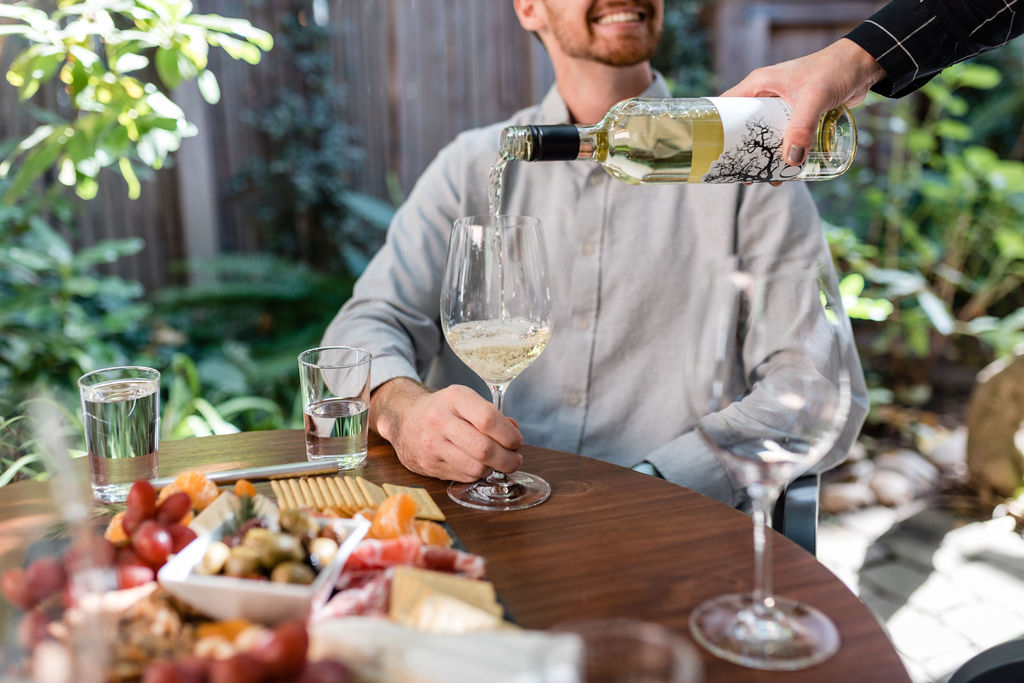
Wine Institute argues that AB 1585 will harm value wines. But the latest research from the Wine Market Council (WMC) suggests the opposite.
Across its 2025 consumer studies, including the Wine & Wellness Report, Eco-Friendly Wine Study, and its work on reducing barriers to purchase, WMC finds that younger and emerging consumers are not looking for the cheapest possible wine. They are looking for affordable wine they can understand and trust. These studies consistently show that “product transparency and clarity are increasingly important,” and that consumers want more information at the point of purchase to feel confident in their decisions.
In that environment, strengthening the integrity of the “American” label is not a liability. It is an opportunity. The future of value wine is not built on obscuring sourcing.
Sustainability, Transparency, and Consumer Trust
That expectation for transparency does not stop at labeling. It extends to how wine is produced and how sustainability is communicated.
The California wine industry has invested heavily in sustainability through programs like the California Sustainable Winegrowing Alliance and the “Certified Sustainable California Winery” designation. These efforts are important and have helped position California as a global leader in sustainable winegrowing. But they also raise a legitimate question.
When the Wine Institute points out that “90% of California wine is now produced in a certified-sustainable winery — up from 80% in 2024,” that is a powerful claim. But what does that actually include? If a winery is certified as “California Sustainable,” what does that mean when it is sourcing significant volumes of imported bulk wine instead of purchasing grapes from California growers? If imported wine is blended into products bottled under that certification, what exactly is being certified?

To consumers, especially younger consumers, sustainability is not just about how a product is packaged or processed. It is about supporting local agriculture, rural communities, and responsible sourcing. It is about alignment between what a company says and what it does.
Blending imported wine into products labeled “American,” while promoting sustainability credentials tied to California production, creates a gap between perception and reality. That gap matters.
The next generation of consumers is paying attention. They want transparency. They want authenticity. And they increasingly want to support companies that support the communities where their products are grown. When policies and practices move in the opposite direction, encouraging imports over local sourcing while promoting sustainability, that disconnect undermines consumer trust. What does sustainability really mean?
The Compliance Argument
Wine Institute has also raised concerns that AB 1585 would create enforcement challenges and compliance burdens. That concern does not reflect how the system works.
Wineries already maintain detailed records of sourcing, production, and blending as part of federal compliance. Appellation standards exist and are enforced. Adjusting the percentage requirement does not create a new system. It applies a clearer standard to one that already exists.
The Uncomfortable Truth
There is another reality in this debate that is rarely acknowledged openly.
Many growers support this legislation quietly but are reluctant to challenge their buyers, especially in a market where hundreds of thousands of tons go unharvested. The leverage sits with a small number of large buyers, and the risk of losing a contract, or simply not getting a call, is real and understood across the industry.
Wineries face a similar constraint. Many work with and depend on the same large companies benefiting from current rules and hesitate to speak out publicly. The result is a chilling effect.
This is not simply a disagreement over labeling. It is a reflection of market power and the pressure that comes with it. Silence, in this environment, is often about protecting financial relationships, not expressing agreement.
That is why it is misleading to suggest there is consensus behind maintaining the current system. Much of the industry does not have the freedom to speak openly on issues that directly affect their livelihoods.
The presence of small, family-owned wineries within the Wine Institute creates the appearance of broad representation. But on critical issues like this, the positions advanced align with a handful of the largest companies at the expense of the rest of the industry.
What This Means for Policymakers
For legislators, doing nothing is not a neutral act. It maintains a system that allows imported wine to be blended into products labeled “American,” even as domestic vineyards are being removed and growers are selling their farms.
AB 1585 is about truth in labeling. It is about the integrity of American wine. And it is about whether public policy should support California farmers and farmworkers.
Wine is not interchangeable. It is rooted in place. If a wine says “American,” it should be made from American grapes. That principle supports consumers. It supports growers. It supports wineries that invest in American agriculture. And it supports our rural communities across California.
Make Your Voice Heard
Now is the moment for growers, vintners, and community members to speak up. Tell them that California agriculture matters, that truth in labeling matters, and that this industry should not be defined by policies favoring imports over the people who grow and produce wine here, Right now, opponents are telling legislators that AB 1585 will drive consumers away from wine. The opposite is true. But that case only gets made if we make it.
The most effective thing you can do is send a letter directly to your state legislators urging them to support AB 1585. These letters do not need to be on company letterhead. They should be short and direct — your name, your connection to the industry, and why this bill matters to you.
Here’s how to submit:
- Print this letter, fill in the date, your name, location, and sign it
- Scan it and send the PDF to info@cawg.org
CAWG will deliver the letters to the committee and each member’s office. Please forward this to friends, family, colleagues, and neighbors — every letter counts. Truth in labeling shouldn’t be controversial. And supporting American agriculture shouldn’t be either.
- See Commission Delegated Regulation (EU) 2019/33, art. 45, requiring wines blended from more than one country to be labeled as a “blend” of wines from different countries rather than as wine of a single country; Wine Australia Regulations 2018 (Cth), s. 24, requiring that if a wine is made from grapes grown in more than one country, the description and presentation must identify the proportion from each country; and New Zealand Wine Regulations 2021, reg. 42, requiring the label to indicate the country of origin and, if imported wine or other specified inputs from another country are used, that country must also be named on the label.
Contact Stuart Spencer with any questions at stuart@lodiwine.com.
Have something interesting to say? Consider writing a guest blog article!
To subscribe to the Coffee Shop Blog, send an email to stephanie@lodiwine.com with the subject “blog subscribe.”
To join the Lodi Growers email list, send an email to stephanie@lodiwine.com with the subject “grower email subscribe.”
To receive Lodi Grower news and event promotions by mail, send your contact information to stephanie@lodiwine.com or call 209.367.4727.
For more information on the wines of Lodi, visit the Lodi Winegrape Commission’s consumer website, lodiwine.com.